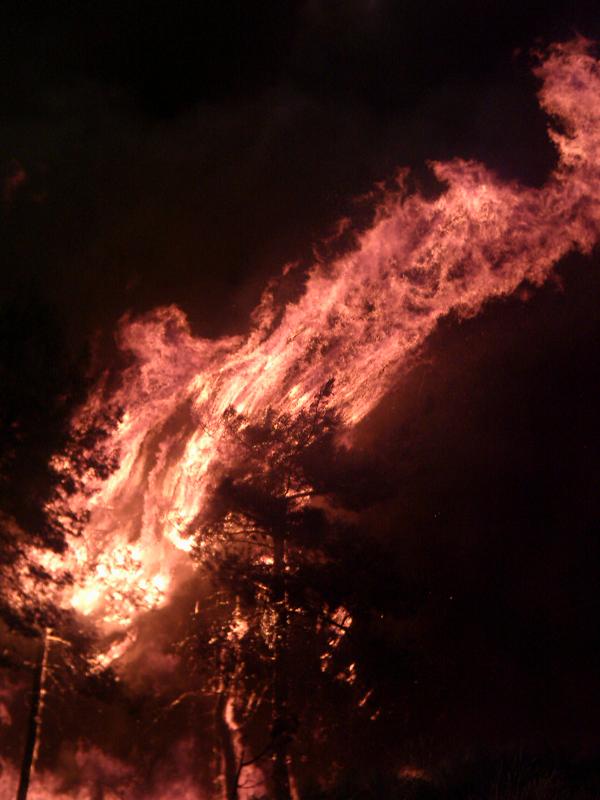
-80% of fires occurring in Europe are given in Peninsula Ibérica.
- Galicia has a 7% of English forests, and their level of fire risk is low because it is the wet Spain. However, it suffers 50% of fires, and about 30% of acres affected in Spain.
-Of 153.000Ha that raged in Spain in 2005, 50.000Ha were Galicia, about half of them in the province of Ourense .
-is, 12 times more likely to burn land in the province of Ourense that at any point in Spain.
There -burn land a rate of two to five years . Burning bushes that came out of the previous fire, burning trees just planted reforestation.
"These areas have an incipient process of desertification ..¡¡¡ EN GALICIA!. The increased erosion causes soil infertility often in rock and the highest incidence of floods and droughts.
"There are municipalities that have fire all the days of summer. If one day missing smoke ... is that the next three. Some municipalities in Raia Seca with little or nothing to burn.
"Only a small part of Mount Orense has not suffered a fire in the past 20 years. The predominant vegetation in Ourense are Xestas , UCESA and other species that follow forest degradation and reforestation of pine . It is almost impossible to find a Carballal more than 20 years, the few that remain are juveniles who were born spontaneously after a fire (the regional government has never significant areas reforested with native species).
"Most fires are caused in areas inaccessible to fall later and several outbreaks in the same area or in waves in the same area. Fires are caused by professional , left to develop in the evening to be the following morning and hits, and dividing the mass extinction which must be focus on protecting towns.
"It is noteworthy that recently the stage of fire is not limited to summer, but also in cold, dry days of winter are waves of fire (some days none, some days five in a handkerchief). While the spread is slower, are much more dangerous for deciduous to be in this time with a very low water content, nearly dry, so they are much more vulnerable to the action of the flames.
I think:
Fire there are everywhere, but in the South of Galicia attend special circumstances which distinguish this problem. In other words: HERE is something wrong. There is a differential feito that distinguishes the inhabitants of the northwestern Iberian peninsula remaining.
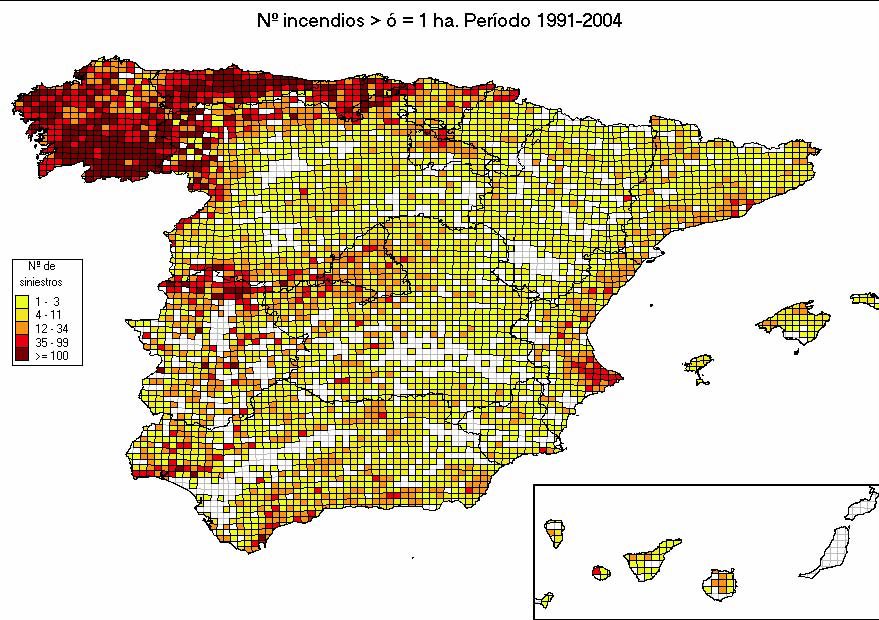
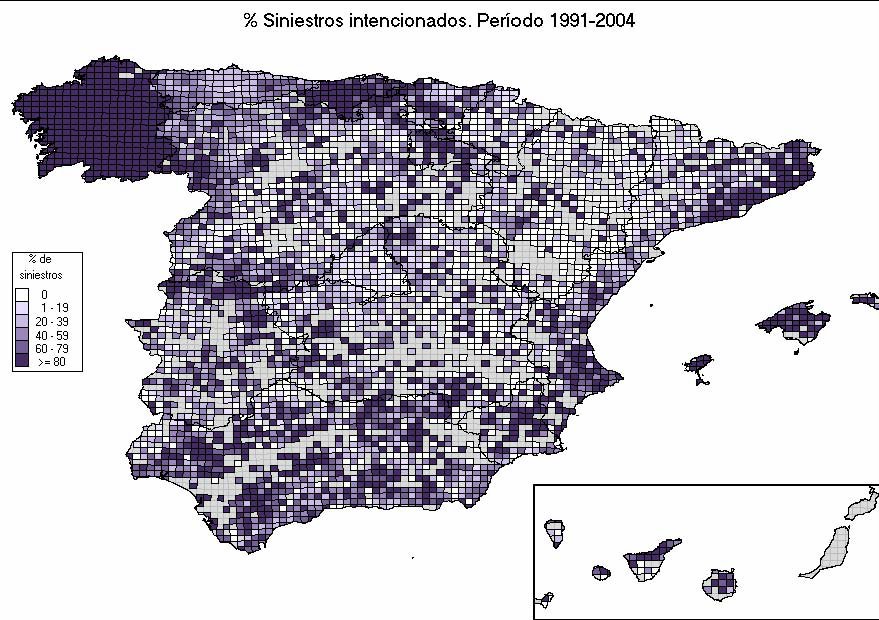 Source: Ministry of Environment
Updated: Data for year 2006 in Galicia.
No. 6,997 fires =
area burnt = 93,887 of which has over 54,000 ha of forested area were .
Between 1 and 4 August has burned 82,418 , ie 88% of the area burned throughout the year. In four days.
Preliminary findings of the Civil Guard argue that there is no connection between fires .
The concentration of fires in four days in response to a coincidence.
I should have a full moon that day.
May this year to change their type and move from burning forests lost in Ourense and Lugo as every year, threatening the Atlantic axis periurban space Galicia is also another chance.
The moon lit up the same ideas.
I realize that the figures do not give a clear idea of \u200b\u200bthe problem, since it is difficult to imagine what all those acres under. Put it on:
De 148,730 has burned throughout the English territory in 2006, has 93,887 corresponded to Galicia. Ie 63% surface was burned in Spain, was in Galicia. Counting
the Galician forest area is 2,039,575 has last year burned the 4.6%, ie one twentieth of Galician forest.
Arguably Galicia has a long hill, the topic forever. Let's see: Spain has 26 million hectares of forest area. Thus, Galicia represents 7.7% Mount English, and accumulated 63% of the area burned.
The question is obvious:
then analyze the causation of forest fires.


0 comments:
Post a Comment